
Arabica vs Robusta Coffee: A Guide for Global Buyers
Published by Prism Exports
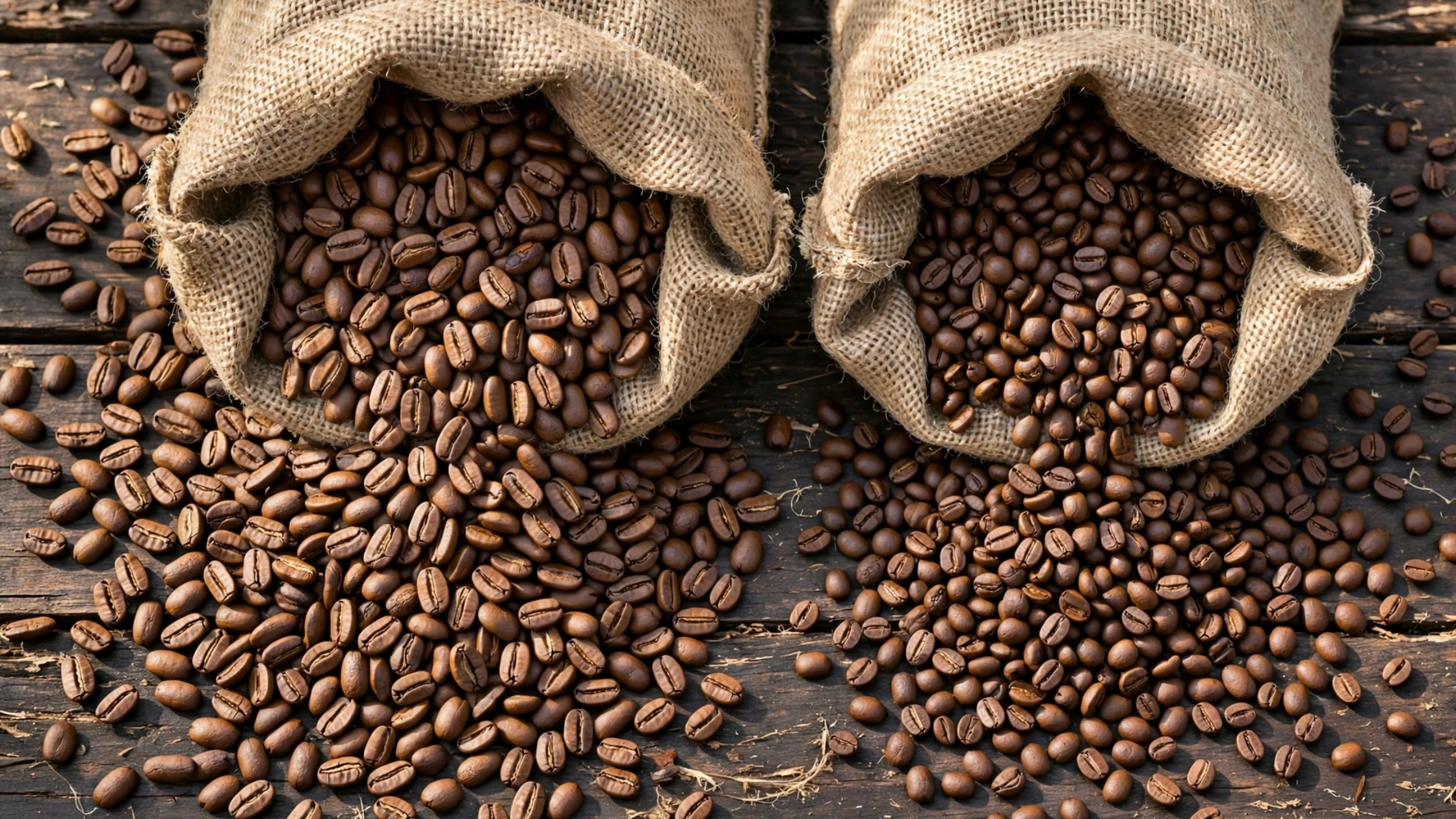
A buyer once asked us why two offers, both from the same district in Karnataka, differed by nearly 40 percent per metric tonne. Same harvest year, same port, same bag size. The answer was species. Arabica vs Robusta coffee is the single largest variable in a green coffee contract, and it moves price, cup profile, shelf behaviour and even how the lot should be stored. Prism Exports helps buyers understand these differences when evaluating Indian coffee for international markets.
If you're building blends for a roastery, a soluble plant or a private-label programme, guessing wrong here is expensive. This guide covers what separates the two botanically and commercially, how Indian supply of each behaves, and the specifications worth writing into your contract before anyone quotes you a number. Working with Prism Exports can help buyers approach coffee sourcing with clear product and contract specifications.

What Actually Separates Arabica vs Robusta Coffee
Coffea arabica and Coffea canephora are different species, not grades of the same plant. Arabica is tetraploid and largely self-pollinating, which is why varietal identity holds up over generations. Canephora, sold commercially as Robusta, is diploid and cross-pollinating, so plots tend to be more genetically mixed.
Practically, the differences you'll feel in a contract are these. Arabica carries roughly half the caffeine, more sugars and lipids, and a higher perceived acidity. Robusta carries more chlorogenic acids and produces a heavier, more stable crema under espresso pressure. Arabica is fussier about heat and rainfall; Robusta tolerates both and yields more per hectare, which is why it sits at a structural discount on the terminal markets.
Growing Conditions and Why the Price Gap Exists
Altitude, Climate and Yield
Arabica wants cooler air and reliable shade, generally above 900 metres, with a slow cherry maturation that builds sweetness. Push it lower and you lose density and cup clarity. Robusta thrives from near sea level up to about 900 metres and shrugs off heat that would stress an Arabica block.
Yield follows. A well-managed Robusta plot commonly outproduces Arabica on the same acreage, and it does so with less spraying. That gap in cost of production, not snobbery, is what keeps the price differential in place year after year.
Disease Pressure and Farm Economics
Leaf rust and white stem borer hit Arabica hardest, and in a bad year an estate can lose a meaningful share of its crop. Robusta's resistance is the reason many Indian estates shifted acreage toward it over the last few decades. When you're comparing Arabica vs Robusta coffee offers, you're partly comparing two different risk profiles carried by the farmer.
Cup Profile, Caffeine and Technical Differences
Most of the Arabica vs Robusta coffee debate happens at the cupping table, but the differences that decide a purchase are measurable. Here's how the two compare on the points that show up in a specification.
Soluble solids matter more than most buyers expect. Robusta gives a higher extraction yield, which is why instant coffee manufacturers lean on it heavily. If you're costing a soluble line, the yield advantage compounds against the raw price advantage, and the gap widens further.
Indian Arabica Coffee: What You're Buying
On the Arabica side of the Arabica vs Robusta coffee question, Indian supply has one distinctive trait: Indian Arabica coffee is almost entirely shade-grown, which is unusual at this scale. Estates in Chikmagalur, Kodagu, Wayanad, the Shevaroys and the Nilgiris sit under a two-tier canopy of native and silver oak, often intercropped with pepper and cardamom. The result is a cup that leans balanced rather than bright: medium acidity, decent body, nutty and sometimes spice-inflected.
Grades follow screen size. Washed lots are sold as Plantation AA, A, B and PB; naturals are sold as Arabica Cherry AA, AB, PB and C. A good Arabica coffee beans supplier separates these cleanly and won't blend a lower screen into an AA to make weight. Ask for screen retention as a percentage and you'll quickly see who grades properly.
Indian Robusta Coffee: The Underrated Half
Indian Robusta coffee deserves more attention than it gets. India washes a larger proportion of its Robusta than most origins, and washed Robusta parchment is a genuinely different product from the sun-dried commodity naturals that shape Robusta's reputation. Cleaner, less rubbery, with the body still intact.
That makes it useful in espresso blends where you want crema and mouthfeel without harshness. Wayanad and lower Kodagu supply most of it. If you're sourcing for espresso rather than soluble, tell your Robusta coffee beans supplier explicitly that you want parchment grades, because the default assumption will otherwise be cherry.
Choosing Between Arabica vs Robusta Coffee for Your Programme
The honest answer is that most commercial programmes use both. What changes is the ratio and the quality tier within each species.
- Speciality filter roasting: Arabica only, high-grown, washed or carefully processed naturals. Robusta has no role here.
- Italian-style espresso: 10 to 30 percent washed Robusta lifts crema and body while Arabica carries aroma and sweetness.
- Soluble and extract manufacturing: Robusta-dominant, driven by soluble solids yield and cost per kilo of extract.
- Ready-to-drink and dairy-based: Robusta-leaning, because the cup has to survive milk, sugar and pasteurisation.
- Private-label supermarket blends: usually a moving ratio, adjusted each season as differentials shift.
Decide the ratio from the finished product backwards, not from the raw material price. A blend rebuilt every quarter to chase the cheapest input loses consistency, and customers notice long before they complain.
One practical note on sourcing. In India, your Arabica coffee beans supplier and your Robusta coffee beans supplier are frequently the same house, which keeps documentation simple and lets you rebalance a blend mid-season without opening a new account.
Specifications to Agree with an Indian Coffee Exporter
Write the contract so species, processing and grade are separate line items. Bundling them causes most of the disputes we see.
1. Species and processing: washed Arabica, natural Arabica, washed Robusta or natural Robusta, stated explicitly
2. Grade and screen retention expressed as a percentage over a stated screen
3. Moisture at loading, typically 10 to 12 percent, with the test method named
4. Defect count per 300 g green sample against an agreed tolerance
5. Cup profile approved against a pre-shipment sample from the actual lot
6. Residue and ochratoxin limits matched to your destination market
Any experienced Indian coffee exporter will hold Coffee Board registration, an IEC code and FSSAI licensing for the processing unit, and should provide phytosanitary and origin certificates as a matter of course. Ask for pre-shipment samples drawn from your lot rather than a type sample.
Frequently Asked Questions
Is Arabica always better than Robusta?
No. Arabica generally cups sweeter and more aromatic, so it dominates speciality filter coffee. But a well-processed washed Robusta beats a poorly handled low-grown Arabica in most espresso applications, and it outperforms Arabica outright in soluble manufacturing. Application decides quality here, not species alone.
How much cheaper is Robusta than Arabica?
Robusta consistently trades at a discount, though the size of the gap moves with crop conditions in Brazil and Vietnam and can swing considerably within a single season. Rather than assuming a fixed spread, ask for both quotes against current terminal months and compare landed cost per kilo of finished product.
Does India produce more Arabica or Robusta?
Robusta accounts for the larger share of Indian production, concentrated in Wayanad and the lower elevations of Kodagu, while Arabica is grown at higher altitudes in Chikmagalur, Kodagu and the Tamil Nadu hills. Both are available for export in commercial volumes, and many exporters offer them side by side.
Can I blend Arabica vs Robusta coffee in one container?
Yes, most exporters will load mixed containers, usually with each species kept in separate, clearly marked lots rather than pre-blended. Keeping them separate protects your flexibility on roast profiles and makes any quality claim far easier to trace back to the specific lot involved.
Conclusion
Arabica vs Robusta coffee isn't a quality hierarchy so much as a set of trade-offs: caffeine, acidity, body, soluble yield, farm economics and price. Once you know what the finished product has to do, the species question usually answers itself, and the harder work shifts to grade, processing and moisture discipline. Prism Exports can help buyers assess these factors based on their required coffee profile and application.
Indian supply gives you both species from one origin, with a strong showing in washed Robusta that many buyers overlook. Start with a clear specification, cup pre-shipment samples from the actual lot, and treat the first container as a test of the supplier's process. If you're still weighing Arabica vs Robusta coffee for a new blend, a detailed conversation with Prism Exports about your volumes and target profile will narrow it down quickly.
Follow Prism Exports on Instagram.



