
Bulk Spice Supplier India: What Buyers Should Check
Published by Prism Exports

A container of turmeric lands at Rotterdam, the lab pulls a sample, and curcumin comes back a full point under contract. Now you’re negotiating a discount instead of selling stock. That’s why choosing a bulk spice supplier India side deserves more scrutiny than a price comparison. Prism Exports understands the importance of consistent quality and reliable specifications when supplying spices for international buyers.
Most overseas buyers start with a quotation and work backwards. It’s the wrong order. Any exporter can match a number on a pro forma invoice; very few hold the same specification across twelve months of shipments. Prism Exports focuses on maintaining dependable quality and export standards, helping buyers make purchasing decisions based on consistency rather than price alone. What follows is the checklist experienced importers run before a first purchase order.
Why Your Bulk Spice Supplier India Decision Sets Your Landed Cost
Price per metric tonne is the smallest part of what you eventually pay. Rejections, re-fumigation, demurrage and a lot stuck at a border awaiting a retest will erase the USD 150 to 250 per MT you saved on the FOB quote. A dependable bulk spice supplier India based often quotes higher and costs less across a year.
Consider the failure modes. A shipment breaching a pesticide MRL in the EU isn’t a discount conversation; it’s destruction or re-export, both on your account. A lot arriving at 13% moisture when you contracted 10% will cake and cost you saleable weight. These aren’t freak events, and the supplier’s systems decide how often they happen.
There’s a simple test. Ask for the last three pre-shipment analysis reports on the same product, buyer names redacted. A serious Indian spice supplier keeps those on file and sends them the same day. A trading desk buying from a mandi will explain why it can’t.
Origin and Crop Belts: Where the Material Actually Comes From
India grows the same spice in several states, and the crops aren’t interchangeable.
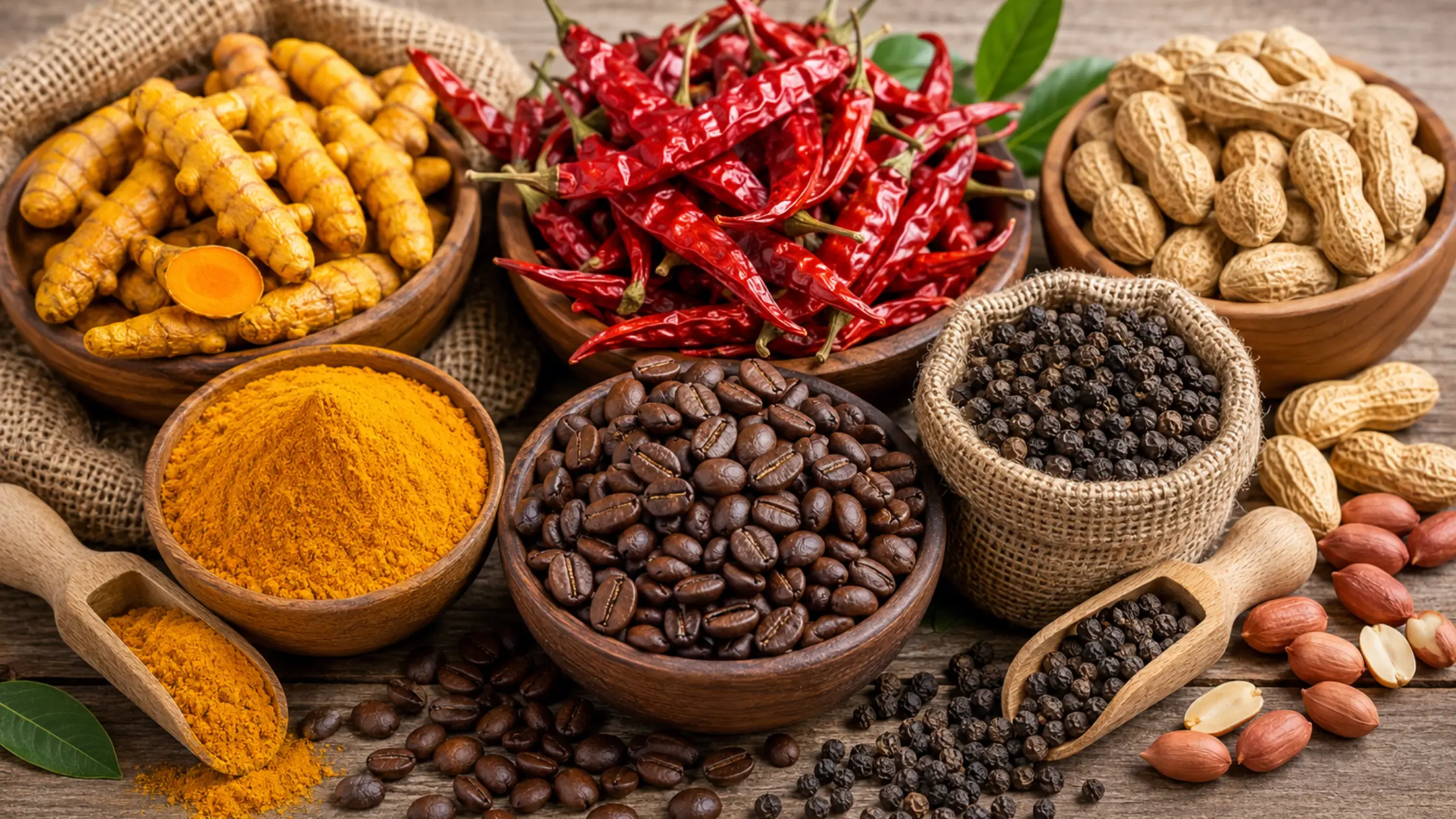
Alt tex : Indian spices and farm products supplied by a Bulk Spice Supplier India.
Matching Grade to Crop Belt
Turmeric from the Erode and Salem belt shows a different curcumin profile from Nizamabad material. Guntur chilli reads differently on colour and heat than Byadgi from northern Karnataka, which is why colour-driven and pungency-driven buyers rarely want the same lot. Cumin is a Gujarat and Rajasthan crop; cardamom sits in Idukki.
Ask which district your material comes from, and whether it stays constant shipment to shipment. An Indian spice supplier who names the belt without pausing is buying at origin. One who says “best Indian quality” buys whatever is cleared cheapest that week.
Buying Around the Harvest Calendar
Arrival seasons move both price and quality. Chilli peaks February to April, turmeric from around February, cumin through March. Fresh-crop material bought soon after arrivals gives better colour and lower moisture risk. Carry-over stock offered in October looks cheaper on paper and disappoints in the bag. A straight Indian spices exporter tells you which you’re being quoted, unprompted.
Quality Parameters That Decide Whether a Lot Clears
Agree the specification in writing before discussing price, because every parameter below carries a cost. Ask your Indian spices exporter to quote against these numbers, not a grade name.
Insist on pre-shipment testing at an NABL-accredited laboratory, and keep the right to appoint an independent inspector at loading. Any competent bulk spice supplier India based accepts that clause. Sampling should follow a documented plan across the lot, not one scoop from the nearest bag.
Documentation Every Bulk Spice Supplier India Should Provide
Paperwork separates credible exporters quickly. Expect a Spices Board of India registration with RCMC, APEDA registration where the product falls under its schedule, and a valid FSSAI licence. Per shipment you’ll need a phytosanitary certificate from plant quarantine, certificate of origin, fumigation certificate where required, invoice, packing list and bill of lading.
Destination documents matter too. Some markets want a health certificate, some a non-GMO declaration, and organic buyers need a valid scope certificate. Ask early: a missing certificate found after loading costs weeks.
MOQ, Packing and How the Container Actually Fills
Minimum order quantity is usually a container, and its limit is often volume rather than weight. Ask any wholesale spice supplier India based to confirm loadability in tonnes before you budget freight.
- 20ft container: roughly 18–19 MT of dense product such as turmeric fingers or cumin
- 40ft high cube: the practical choice for light, bulky whole chilli, where you may reach only 8–12 MT
- Packing: 25 kg or 50 kg PP bags with food-grade liners, jute bags, cartons, or one-tonne big bags
- Palletised vs floor loaded: pallets cost cubic capacity but save discharge labour and bag damage
- Marking: lot number, net and gross weight, crop year and destination marks
Buyers wanting smaller volumes can usually get an LCL shipment of a few tonnes at a higher per-kilo cost. A wholesale spice supplier India based should explain that difference rather than simply refusing.
Incoterms, Payment Terms and Realistic Lead Times
Most business is quoted FOB from Nhava Sheva, Mundra, Chennai or Tuticorin, with CFR and CIF available. FOB gives you the freight booking, which saves money if you have a forwarder. CIF suits buyers who’d rather hand over the chain.
On payment, an irrevocable letter of credit at sight is the usual middle ground for a new relationship. Documents against payment appears once trust is established, and full advance is normal only for small trial lots. A bulk spice exporter India based demanding 100% advance on a full container from a first-time buyer is asking you to carry every risk.
Lead times of 15 to 30 days from confirmed order to loading are realistic for ready stock, longer when sortex, steam sterilisation or grinding is involved. Add ocean transit: three to five weeks to Europe, longer to the Americas.
Questions to Ask a Bulk Spice Supplier India Before You Sample
1. Which district and crop year is this lot from?
2. Do you own the processing unit, or is it toll-processed elsewhere?
3. Which parameters do you test in-house, and which go to an external lab?
4. What’s your position if a lot fails at my destination port?
5. Can you hold this specification across four shipments in a year?
6. Which markets have you shipped this exact product to?
The answers matter less than the manner. Precision, a willingness to say “we can’t do that”, and fast access to records are the signals worth trusting. Vague enthusiasm from a bulk spice exporter India based is not.
Frequently Asked Questions
How do I verify a bulk spice supplier India before ordering?
Check the Spices Board registration and FSSAI licence numbers directly, request redacted pre-shipment reports from recent shipments, and ask for two references in your own region. Then order a paid sample against a written specification and test it independently. A video walkthrough of the processing line is a fair request.
What’s a realistic minimum order for a first purchase?
One 20ft container is the standard minimum with most bulk spice supplier India operations, though many accept LCL trial lots of three to five tonnes at a premium of a few hundred dollars per MT. Trial orders earn their extra cost because they test the whole chain, not just the product.
Who pays for third-party laboratory testing?
Pre-shipment testing at the supplier’s accredited lab is normally built into their price. If you appoint an independent inspector or a lab of your own choosing, you usually pay, and it’s money well spent on a first shipment. Many buyers split the cost once the relationship settles.
Can a supplier guarantee my shipment clears EU customs?
No honest exporter guarantees clearance, because MRL lists change and testing has natural variation. What a good Spice Supplier India can do is test against your destination’s current limits before loading and share the raw report. Treat any absolute guarantee as a warning sign rather than reassurance.
Conclusion
The buyers who get consistent results aren’t the ones who negotiated hardest on the first quote. They’re the ones who wrote a tight specification, checked the paperwork properly, insisted on pre-shipment testing against their own destination limits, and started with a trial lot before scaling to regular volume. Choosing a bulk spice supplier India side is a supply chain decision rather than a purchasing one, and it rewards patience in the first month far more than speed. The exporter who asks you awkward questions about your destination’s residue limits before quoting is usually the one worth working with. Prism Exports understands the importance of quality consistency, proper documentation, and export requirements when supporting international buyers.
If you’re comparing quotations and want to know what a fair specification and payment structure should look like for your market, a conversation with Prism Exports can help you get practical answers matched to your product requirements and volumes Get in Touch with Prism Exports .



